The Planet Board Game is an innovative tile placement game by Blue Orange Games.
advert: product gifted by coiledspring games

What makes the game so strikingly different, is that the tiles are placed on 3D planet cores rather than on a tabletop!
Other tabletop game reviews you may also like to read include KINGDOMINO, CODENAMES ORIGINAL FUNKO; SOMETHING WILD,


This post contains some affiliate links for your convenience (which means if you make a purchase after clicking a link I will earn a small commission but it won’t cost you a penny more)! As an Amazon Associate, I earn from qualifying purchases
Page Contents
Aim Of The PLanet Board Game
The aim of the game is for players to score points by adding continent tiles to their planets core and creating an ideal habitat to win animal cards. The winner is the player with the most points at the end of the game.
What’s In The Planet Board Game Box
- Four planet cores
- 50 continent tiles
- 45 animal cards
- Five “natural habitat” objective cards
- First player token
- Spare metal circles

The planet cores are well made and the metal circles that the magnets stick to are firmly stuck in place. And the magnetic continent cards are solid with no flex to them. Although the animal and objective cards are thin, like a deck of cards, they are well made with a beautiful semi-glossy finish. The ‘first player token’ stands out as it’s made of very thick card
The PLanet Board Game Set Up
One of the interesting things about the Planet Board Game is that all the animal cards in play are laid face up on the table at the start of the game. This allows players to formulate a tentative plan based on their objective card.
Each player is given a planet core.
The continent tiles are lined up in 10 piles of 5 tiles, with images placed facing down. The animal cards are shuffled and 20 cards drawn out and placed face-up next to the tiles as in the image below.

Each player also receives 1 objective card that is dealt out face down so only the player can see it.

The player that is going first is given the ‘First Player Token‘
How to play PLanet
Players take it in turn, over 12 rounds to collect continent tiles that contain habitat areas. There are 5 types of habitat
- Forest/Grassland
- Mountainous
- Desert
- Glacial
- Oceanic
Each round consists of 2 parts
Adding continents
The first player takes the first pile of 5 continent tiles and spreads them out across the center of the table, face up. They choose one tile from these 5 and add it to a free space on their planet’s core. The other players then take turns doing the same. Any tiles remaining are placed on the 11th spot. The first player tile is given to the next player the second pile of continent tiles is spread out and the new first player takes a tile followed by everyone else. Again leftover tiles are put on the 11th spot until there are 5 and then the tiles are built up on the 12th spot. when there are 5 tiles on the 12th spot remaining tiles are placed back in the box.

When the third pile of continental tiles have been chosen players then get to start trying to win the animal cards.
2. The origin of life (animal cards)
From the third turn onwards, life can start to emerge on the planets.
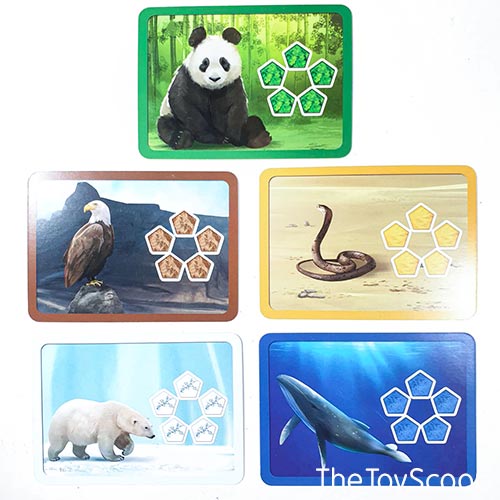
The animal cards can have 1 of 3 requirements in order to be won;
- having the most of one kind of region. A region is an isolated patch of habitat. So one big patch of interlocking habitat over multiple tiles would be classed as only 1 region!
- having the biggest region of one type of habitat that also touches another specific habitat.
- having the biggest region of one type of habitat that does not touch another specific habitat.

An area is defined as a triangular portion of a tile, and a region is one or more areas that are connected together.
All the players check to see if their planet meets the conditions required to host the animal cards available during that particular round. The player who possesses the most habitable planet for the animal takes the card and keeps it in front of them.

If an animal card cannot be won due to a tie, or because no players have the correct habitat, it is placed in the column for the NEXT round.
In the last (12th) round, if an animal card cannot be won by having the most of one kind of region, it is returned to the box. With both the other card scenarios if there is a tie, the players look at their second-biggest suitable habitat area and the winner takes the card. In the unlikely event of another tie, they look for a 3rd suitable habitat area.
Game End
The Planet board game ends after the 12th round; when the player’s planets are fully covered and the last animal cards have been won.
Each player checks whether or not they have met their objectives, winning points if they have succeeded. They also and score 1 point for every animal that has the same habitat as their objective card and two points for animals in habitats that are different to their objective cards.
When everyone has added up their points the player with the most points wins the game!
Other educational reviews you may like; Q-BITZ EXTREME, CRYSTAL GROWING LAB, and CODE PIANO


Educational Aspect Of The Game
More and more board games are indirectly linked to stem subjects, and the Planet board game is no exception. Kids will be reinforcing their understanding of habitat types and the type of animals that live there. I do think the game makers missed a trick, as it would have been nice to have the animal names printed on the cards as well. And of course, the very nature of the game supports problem-solving and mental maths skills.

Packaging
There is minimal packaging. The cards come wrapped in plastic wrap, which is the only throwaway packaging element. There is a plastic insert in the box but that helps sort all the parts when they are put away.
What Do We think of PLanet?
The Planet Board Game is beautiful to both view and play. It’s well made and should last a long time if looked after and packed away properly. I like that they have provided spare metal disc to attach to the planet core.
The animal card illustrations are clear and I like the ‘win requirement symbol styling. It would have been nice to have the animal name in text on the card as well as the photo image. Most adults will know the animals but kids will find a few of them harder to identify without help. Not that you need to know the names of the animals to play the game. It would just have been a nice extra.

It’s a fantastic family game and its uniqueness is definitely part of the appeal but underneath it’s actually quite a tricky game to play. For a start laying tiles on a 3D shape adds more difficulty to what is essentially a standard tile placement game. It was a clever choice to have opposing requirements to win cards… some cards require you to have two types of habitat touching to win them but that habitat set up can stop you from winning other types of animal cards. Plus of course you don’t know what continent tiles are going to head your way!
Add into that the secret objective card and the fact that you score less point for an animal that is from the same habitat as your habitat objective card, and you get a game that has a lot more depth to it than its appearance suggests.
It sounds complicated but the rules are easy to follow and the game is very straightforward to play. Which is a good indicator of a great game.
The mix of strategy and luck makes an interesting game.